
At-Home Practice: Ingredient List
Students practice their Food Detective ingredient list skills at home.
Students practice their Food Detective ingredient list skills at home.
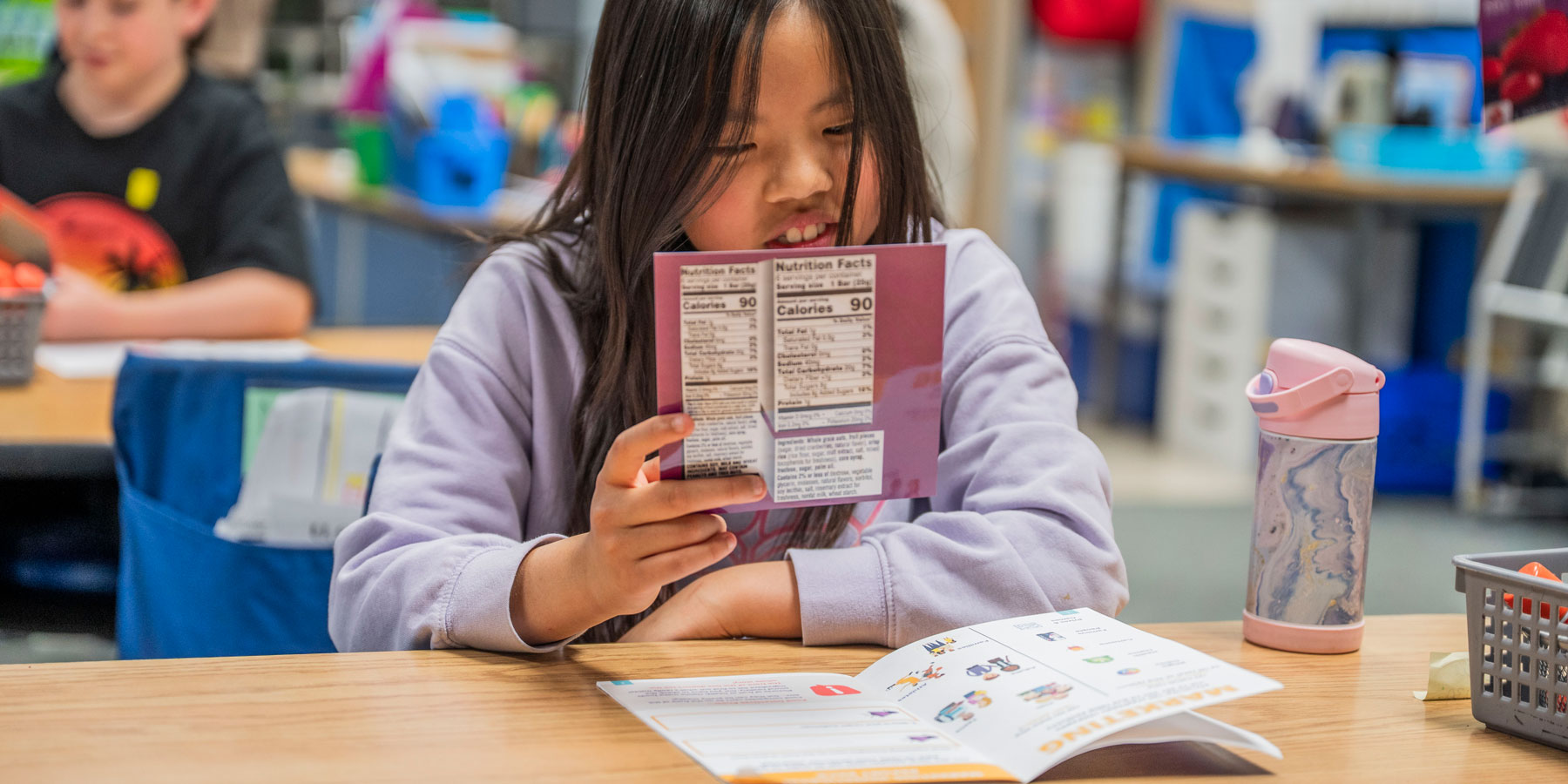
Download Lesson Plan Download Student Worksheet
Estimated Time: <5 mins Explanation
OVERVIEW
After finishing the Back of the Box (ingredient list), students are now well equipped to practice their
skills at home! Print the supplemental worksheet to build off what they know about ingredient lists.
LEARNING TARGETS
Students will be able to investigate a food product at home to analyze the ingredient list and
determine whether the product is being truthful in their marketing.
MATERIALS
• Printed worksheet
INTRODUCTION: Example Script
Alright class, it’s time to put your ingredient list knowledge into action! Your mission is to find one food
product from your pantry or kitchen and investigate its marketing strategies. Let’s go through the
sheet together to ensure there’s no questions when you’re doing your homework.
1. Choose a Food Product
• Look for something you enjoy, like cereal, snacks, or a drink.
2. Complete the Worksheet
• You will fill out a worksheet with several prompts.
• Write down the name of the product and a brief description of what it is.
• Next, look at the ingredient list. You’ll answer whether it’s long or short and if you can
picture the ingredients in your head.
• The next question is a little tricky, because it requires you to look at the marketed flavor
on the front and if you can find that flavor in the ingredient list. For example, if
something has pictures of strawberries, does it actually have strawberries in the
ingredient list?
• The final questions asks you to thinking critically and answer if you think the product is
being truthful based on the marketing on the front of the package and what you see in
the ingredient list.
3. Submit Your Worksheet
• Once you have completed the worksheet, please turn it in by the due date. Be prepared
to share your findings with the class!
ASSESSMENT
• To assess the Food Detectives @ Home worksheet, focus on the clarity and completeness of
students’ responses.
• Check that the students accurately identified the number of ingredients in the ingredient list
and assess whether it’s realistic that they can picture most of the ingredients in their head.
• Evaluate their reasoning as to why they feel like the product is being truthful in their marketing,
ensuring they provide thoughtful explanation.
• Provide constructive feedback to guide their understanding of marketing strategies and
ingredient list.
LEARNING STANDARDS
Common Core State Standards (CCSS) for 4th Grade ELA
1. Reading Informational Text:
• RI.4.1: Refer to details and examples in a text when explaining what the text says
explicitly and when drawing inferences from the text.
• RI.4.2: Determine the main idea of a text and explain how it is supported by key details.
2. Writing:
• W.4.2: Write informative/explanatory texts to examine a topic and convey ideas and
information clearly.
National Council of Teachers of English (NCTE) Standards for 4th Grade
• Standard 3: Students employ a wide range of strategies as they write and use different writing
genres appropriately.
• Standard 4: Students use spoken, written, and visual language to communicate effectively.